MemoHoney: The Case File
We traced MemoHoney across its own storefronts, compared what each one lists on the label, and checked its guarantee terms and its name against public scam-reporting. Here's exactly what we found — and why we ended this page with an alternative ingredient instead of an order button.
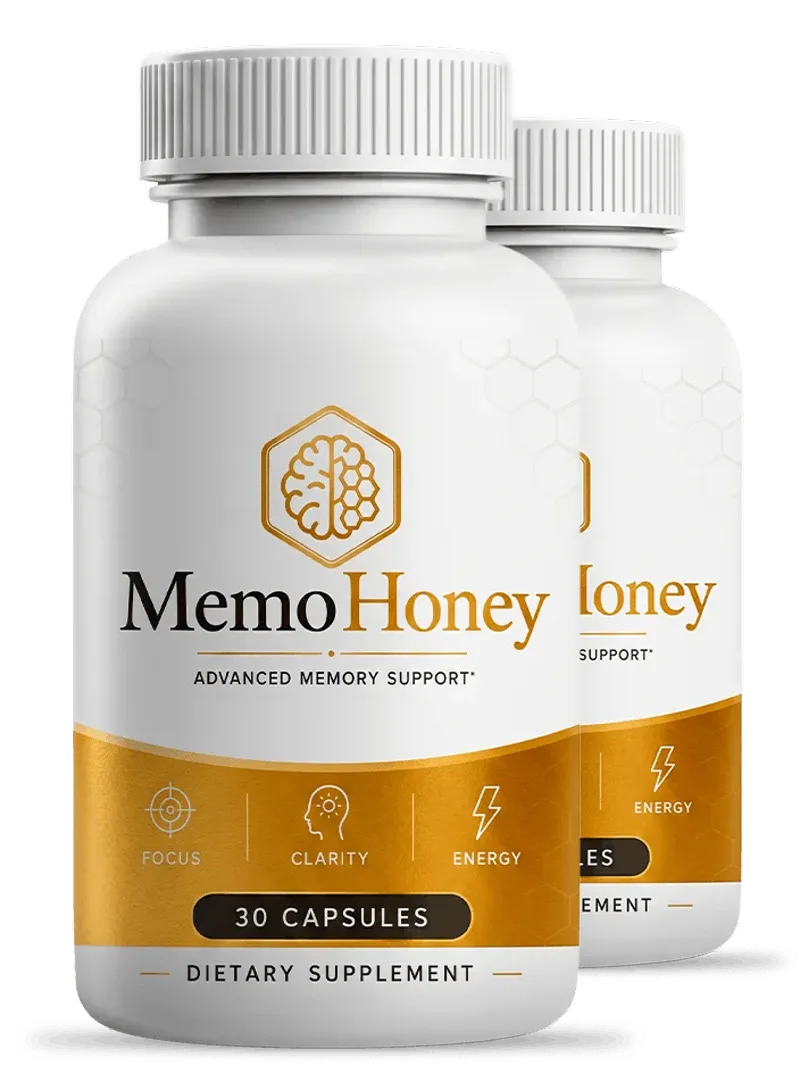
01 What MemoHoney claims to do
Across the storefronts we checked, MemoHoney is marketed as a once-daily capsule for "natural daily support for memory, focus & mental clarity." One current storefront's own hero copy describes it as "designed to promote mental clarity, focus, reduced brain fog, daily energy, and overall cognitive wellness," and adds, in the same breath, that "individual experiences may vary based on lifestyle and consistent use."
That hedge turns out to matter, because the same storefront's own FAQ walks the claim back further. Asked directly whether MemoHoney works, it answers that the product "is designed primarily to support healthy brain circulation through nitric oxide production rather than directly treating memory problems," and states plainly: "The finished formula itself has not been independently tested in clinical trials."
That admission — from the seller's own FAQ, not from us — is a reasonable starting point for reading everything else on this page. Nothing below contradicts it.
It's also worth flagging what the ingredients are actually built around. Two of the amino acids used in the most common label — L-Arginine and L-Citrulline — work primarily through nitric oxide and blood flow, which is the same mechanism used in blood-pressure and exercise "pump" supplements, not a mechanism typically associated with memory-specific nootropics like Bacopa Monnieri or Ginkgo Biloba (which, confusingly, show up on two of MemoHoney's other ingredient panels — see the next section).
02 The label: three ingredient lists
The single biggest problem we found is that "MemoHoney" does not point to one consistent formula. Depending on which storefront or third-party listing you read, you'll see one of three different ingredient panels under the same product name and the same bottle design:
| List | Where we found it | Ingredients | Contains honey or cinnamon? |
|---|---|---|---|
| A — "amino-acid" formula | Live storefront (memohoney-us.us) & a syndicated GlobeNewswire label-disclosure release, Aug 17, 2026 | Niacin (B3), Calcium (as carbonate), L-Arginine, L-Arginine AKG 2:1, L-Citrulline HCl, L-Citrulline Malate, Beta-Alanine | No |
| B — "nootropic" formula | Independent product-review coverage | Bacopa Monnieri, L-Theanine, Ginkgo Biloba, Rhodiola Rosea, Phosphatidylserine | No |
| C — "honey-botanical" formula | Separate independent coverage, and the ingredient set referenced around the "honey ritual" ad campaigns discussed in Section 6 | Astaxanthin, Ginkgo Biloba, Bacopa Monnieri, honey, blueberry | Yes |
In other words: the version of MemoHoney that's easiest to actually buy right now — List A, live on memohoney-us.us as of this research — contains no honey and no cinnamon at all, despite the name and despite the "ancient honey ritual" framing used to sell the concept elsewhere.
Doses: disclosed in one place, missing everywhere we could actually order
The Aug 17, 2026 GlobeNewswire release does publish milligram amounts for List A: Niacin 7.5 mg, Calcium 18 mg, L-Arginine 200 mg, L-Arginine AKG 2:1 200 mg, L-Citrulline HCl 100 mg, L-Citrulline Malate 100 mg, Beta-Alanine 40 mg. But that's a syndicated press placement, not the checkout page. On the live storefront itself, the ingredient section names the same seven items and describes each one in a paragraph of marketing copy — with no supplement-facts panel and no milligram figure next to any of them. If you only look at the page you'd actually order from, you cannot tell how much of anything is in the capsule.
A safety-relevant detail sits inside that same FAQ: MemoHoney warns that "individuals taking blood pressure medications, nitrates, PDE5 inhibitors, or those with kidney conditions should consult a healthcare professional before beginning supplementation because of potential interactions." That warning exists because of the amino-acid/nitric-oxide ingredients in List A — another sign that this formula was not built around memory-specific botanicals, whatever the marketing headline says.
03 Who actually sells it
We found at least eleven separately registered domains presenting themselves as the "official" MemoHoney site, several of them cross-linking to one another in hidden footer link lists on their own pages: memohoneyofficial.com, memohoneyy.com, us-memohoney.org, en-memohoney.com, memohoney-com.com, memohoney-us.us, memohoneysupplement.com, memo-honeys.com, thememohoney.com, memo‑‑honey.com, and memohoney.ca. We're naming them for transparency, not linking to them.
Behind those storefronts, we could confirm three different claimed company identities, none of which appear consistently:
- No company named at all. The storefront we reviewed in detail (memohoney-us.us) carries no manufacturer name, no legal entity, and no address anywhere on the page — its footer reads only "© Copyright – MemoHoney."
- Instituto Experience — listed as the "distributor," PO Box 12730, Ogden, UT 84404, in the Aug 17, 2026 GlobeNewswire label-disclosure release.
- Ridgewater Brands, LLC of Boise, Idaho, cited elsewhere with a registration number (ID-LLC-4471902) as the entity selling MemoHoney.
We could not find one page, on any storefront, that names all of these consistently or explains how they relate to each other. That matters practically: if something goes wrong with an order, "MemoHoney customer support" isn't a single company you can look up — it's whichever of these (or another storefront entirely) happened to process your payment.
04 Pricing and checkout
The storefront we reviewed uses tiered bundle pricing with a struck-through "was" price next to a lower "now" price — for example, a 2-bottle order is framed as $358 marked down to $158 plus $9.99 shipping, a 3-bottle order as $537 marked down to $207 with free shipping, and a 6-bottle order as $1,074 marked down to $294 with free shipping. We're describing this pricing structure as we found it during this research, not quoting current prices; if you're comparing options elsewhere, treat any specific number you see on a MemoHoney storefront as something to verify at the time, not something to rely on from this page.
We also checked where the order button actually goes. On the storefront we reviewed, every "Buy Now" and "Order Now" button routes through a third-party affiliate-tracking domain (maxwebconnect.com) rather than to a checkout hosted by the storefront itself or by any of the three company names above. That's a common setup for pay-per-sale affiliate marketing and isn't automatically evidence of fraud on its own — but it does mean the page you're reading and the company that ultimately bills your card are not necessarily the same, and that a "review" praising the storefront may be paid on the same commission basis.
05 The "60-day guarantee"
"MemoHoney comes with a 60-day money-back guarantee, giving customers time to evaluate the product and decide whether it meets their expectations. If you are not satisfied with your MemoHoney experience during the guarantee period, you can contact customer support and request assistance in accordance with the refund policy." — as stated on a live MemoHoney storefront, September 2026
Two things are worth checking against that promise before you rely on it:
- The same Aug 17, 2026 press release that names "Instituto Experience" as distributor at PO Box 12730, Ogden, UT 84404 lists a return address of PO Box 12730, Ogden, UT 84412 — a different ZIP code for what should be the same box, in the same document.
- Because at least three company identities and eleven-plus domains are associated with this product, "contact customer support" doesn't point to one accountable business. Which company actually owes you a refund depends on exactly which storefront processed your order.
We did not find an independent, verifiable record — a Better Business Bureau case, a news report, a court filing — confirming that this guarantee is honored in practice. The only evidence for it is the sellers' own on-page claim. That doesn't prove refunds are refused; it just means there's nothing beyond the seller's word to check it against.
06 Things worth knowing before you decide
-
1
A false "FDA Approved" claim, in the seller's own words
One storefront headlines a trust badge "FDA Approved" and its FAQ goes further, stating outright: "Yes, Memory Honey Capsules is approved by the FDA before being marketed." That's not accurate. The FDA does not approve dietary supplements before they go to market — it can register a manufacturing facility, which is a different, much lower bar. Elsewhere on the very same page, the softer and accurate phrase "FDA-registered facility" is used, which makes the "approved" claim read like a deliberate upgrade rather than a slip.
-
2
A 5.0-out-of-5 rating from "44,628 reviews" you cannot see
The same storefront displays a five-star graphic next to "(44,628 Reviews)" and the line "Rated 5.0/5 by verified customers," with no link to a review platform, no filtering, and no way for a visitor to read a single one of those reviews. We're describing this claim, not endorsing it — we could not verify it, and a perfect average across that many reviews is itself unusual for any consumer product.
-
3
A real, verified Trustpilot complaint about mismatched contents
A reviewer identified as "Jo Jo B." left a one-star review of memohoneyofficial.com on Trustpilot on August 24, 2026, stating: "none of the ingredients listed on the website are actually in the capsules…it is obviously a fake." We can't confirm this experience for every buyer or every storefront, but it's a specific, named, dated complaint that lines up with the label inconsistencies documented in Section 2.
-
4
A documented naming overlap with an active AI deepfake health scam
Separately from anything MemoHoney's storefronts say about themselves, consumer-protection reporting (Snopes, Forbes, and local news outlets) has fact-checked a widely circulated scam sometimes called "Bill Gates Brain Honey" or the "cinnamon and honey ritual," which uses AI-generated deepfake video and voice of Bill Gates, Dr. Sanjay Gupta, Anderson Cooper, and Bruce Willis to falsely claim a honey-based recipe reverses Alzheimer's or dementia. Bill Gates' office has denied any involvement, and the Alzheimer's Association has stated it does not endorse any food, ingredient, or supplement as treating or preventing Alzheimer's.
We found a direct, if limited, thread connecting that world to MemoHoney: the hidden footer on the memohoney-us.us storefront — the same footer that links out to other MemoHoney clone domains — also links to a nearly identical clone network for a differently branded "Cognihoney" product, built from what is obviously the same web template. Cognihoney has been separately reported elsewhere as running deepfake Bill Gates video ads. We want to be precise about what that does and doesn't show: it demonstrates the same operator (or template vendor) runs storefronts for more than one "brain honey"-style product name, one of which has been reported using deepfake celebrity ads. It does not confirm that the specific MemoHoney capsules sold on any given storefront are the identical SKU being pushed through those deepfake video funnels. Treat the connection as documented but unconfirmed at the individual-product level — and treat any video ad using a recognizable public figure to sell a memory or Alzheimer's product as false until proven otherwise.
-
5
Which ingredients you get depends on which site you order from
See Section 2. There is no single MemoHoney formula we could confirm — there are at least three, one of which doesn't contain the product's own namesake ingredient.
07 A disclosed-dose alternative we could verify
Given everything above, we're not linking to MemoHoney or to any of its storefronts. If you're specifically interested in a memory-and-cognition ingredient with a consistent, disclosed dose and published human research behind it, standardized Bacopa Monnieri extract is a reasonable one to compare products against.
Two peer-reviewed randomized, placebo-controlled trials give a sense of what's actually been studied: a 2006 trial in the Indian Journal of Psychiatry (Raghav et al.) gave adults with age-associated memory concerns 125 mg of standardized Bacopa monniera extract twice daily for 12 weeks and found improvements in mental control, logical memory, and paired-associate learning versus placebo. A 2016 six-week trial in Evidence-Based Complementary and Alternative Medicine (Kumar et al.), using 150 mg of standardized Bacopa monnieri (Bacognize®) twice daily (300 mg/day total), found statistically significant improvement on tests of logical memory and working memory in medical students compared with placebo.
That's a meaningfully hedged claim, not a promise: standardized Bacopa Monnieri may support memory and learning with consistent daily use over several weeks in the populations these trials studied — it is not a treatment for Alzheimer's, dementia, or any diagnosed condition, and individual results vary. When comparing products, look for one with a disclosed standardization (for example, a percentage of bacosides, or a named extract like Bacognize®) and a milligram dose printed on the label — exactly the information MemoHoney's own storefronts don't consistently provide.
Compare standardized Bacopa Monnieri options on Amazon
This search shows current listings so you can compare labeled doses, standardization, and seller ratings for yourself. As an Amazon Associate, we earn from qualifying purchases.
Compare Bacopa Monnieri listings on Amazon →Prices and availability change constantly on Amazon, so we're not quoting a number here — check the listing itself. This is not a claim that any specific listed product is superior to MemoHoney; it's an example of an ingredient with disclosed dosing and named published research behind it.
08 FAQ
Is MemoHoney the same product as the "Bill Gates brain honey" Alzheimer's videos?
Not confirmed either way at the individual-product level. What we could verify is a naming and network overlap: a hidden link on one MemoHoney storefront points to a "Cognihoney" clone site built on the same template, and Cognihoney has separately been reported running deepfake Bill Gates ads. That's a documented connection between the surrounding network and that scam, not proof that any specific bottle of MemoHoney is the same SKU. See Section 6 for the full detail.
Does MemoHoney actually contain honey or cinnamon?
It depends which storefront's ingredient list you're reading. The version we found live on a current storefront (List A) contains neither. A different ingredient list we found in other coverage (List C) does include honey. See Section 2 for all three lists side by side.
Is MemoHoney FDA approved?
No. Dietary supplements are not approved by the FDA before they're sold in the United States — the FDA can register a manufacturing facility, which is a lower and different bar. One MemoHoney storefront's FAQ states it "is approved by the FDA before being marketed," which is inaccurate as written. See Section 6.
How much of each ingredient is actually in a MemoHoney capsule?
A syndicated press release lists specific milligram amounts for one of the three ingredient sets (List A). The live storefront selling that same formula does not print any milligram amounts on the page you'd actually order from. See Section 2.
Who do I contact if I already bought MemoHoney and want a refund?
Start with whichever website you actually placed the order through — check your card or PayPal statement for the billing descriptor, since it may not match "MemoHoney." We found at least three different company names associated with the product and no single verifiable customer-service channel. See Sections 3 and 5.
What would you actually recommend instead?
If you want a memory-support ingredient with a disclosed dose and named published human research, look at standardized Bacopa Monnieri extract — see Section 7 for the specific studies and a comparison link.
09 Bottom line
We're not pointing you to MemoHoney, from any of its storefronts.
Not because we can prove it's the deepfake Alzheimer's scam wearing a different name — we can't, and we've been explicit above about what is and isn't confirmed. It's because everything we could independently verify points the same direction: three contradictory ingredient lists sharing one product name and one bottle design, doses disclosed in a press release but missing from the page you'd actually order from, three different company identities with no page tying them together, a false "FDA Approved" claim in the seller's own FAQ, an unverifiable five-star rating claim, a real named Trustpilot complaint alleging the capsules don't match the label, and a checkout button that redirects through a third-party affiliate network rather than a company you can identify.
Any one of those on its own might be an oversight. Together, they describe a product you cannot currently verify the contents, ownership, or accountability of before paying. If your goal is memory or cognitive support specifically, we'd rather point you to an ingredient with a disclosed dose and named research behind it — see Section 7 — than to a bottle we can't tell you the actual contents of.